08/09/2021 Bought A Condo home in 2021 in Indianapolis, IN.
Local knowledge ***** Process expertise ***** Responsiveness ***** Negotiation skills *****
We were referred to Shawna by a mutual friend. She acted as if she had known us for years and there was an instant mutual trust. She had 5 properties set up on the first day we met, and we purchased the very first one viewed! She was so easy to work with and we would genuinely call her a friend from here forward. She made the process supper easy, even though we were negotiating from 3hrs away!!
It was a very simple, professional, and fun experience to buy this property.
08/03/2021 Bought and Sold a Single Family home in 2021 in Fishers, IN.
Local knowledge ***** Process expertise ***** Responsiveness ***** Negotiation skills *****
Shawna was a joy. We worked over 3 years to find the perfect home. Shawna was very attentive to all my concerns. She was able to get me in on last minute showings. Our buyer’s agent loved doing business with her and that made our buying experience amazing. All aspects went smooth and efficient.
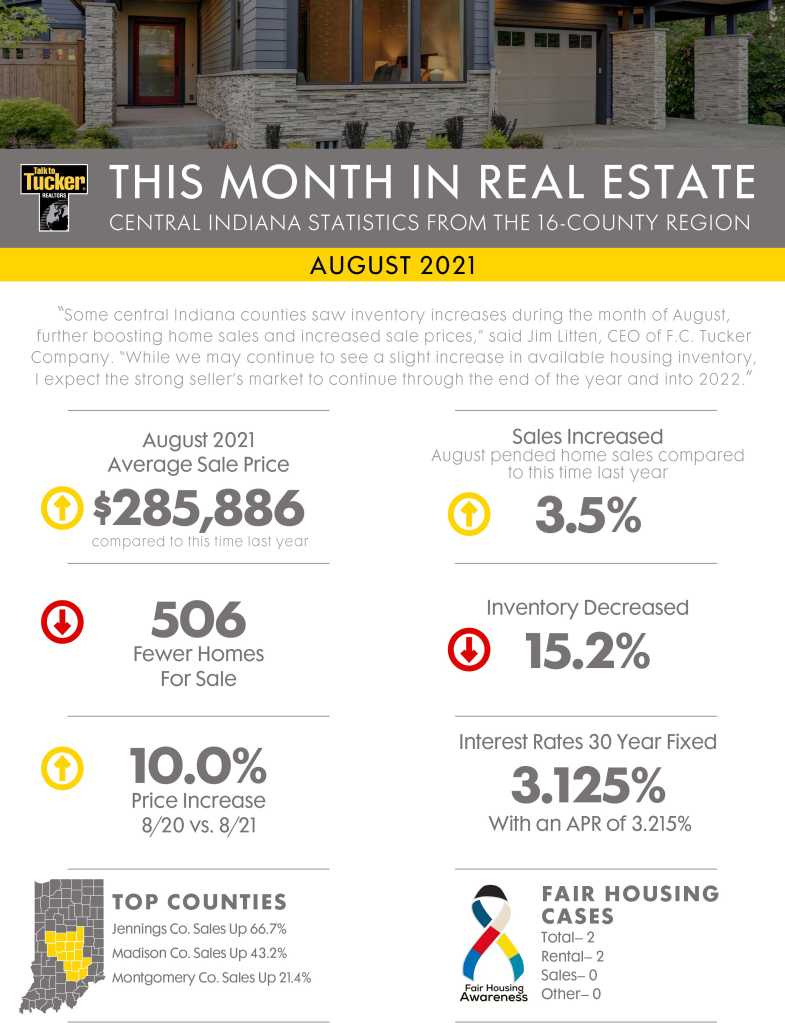
Fueled by a slight increase in housing inventory in some areas, central Indiana’s residential real estate market ended the summer on a strong note — with robust home sales and price increases.
Monthly real estate statistics from F.C. Tucker Company revealed that August’s pended home sales increased 3.5 percent compared to August 2020.
In addition, year-to-date home prices increased 13 percent, and available housing inventory decreased 15.2 percent compared to this time last year. The average August 2021 home sale price for the 16-county central Indiana region was $285,886, an increase of 10 percent.
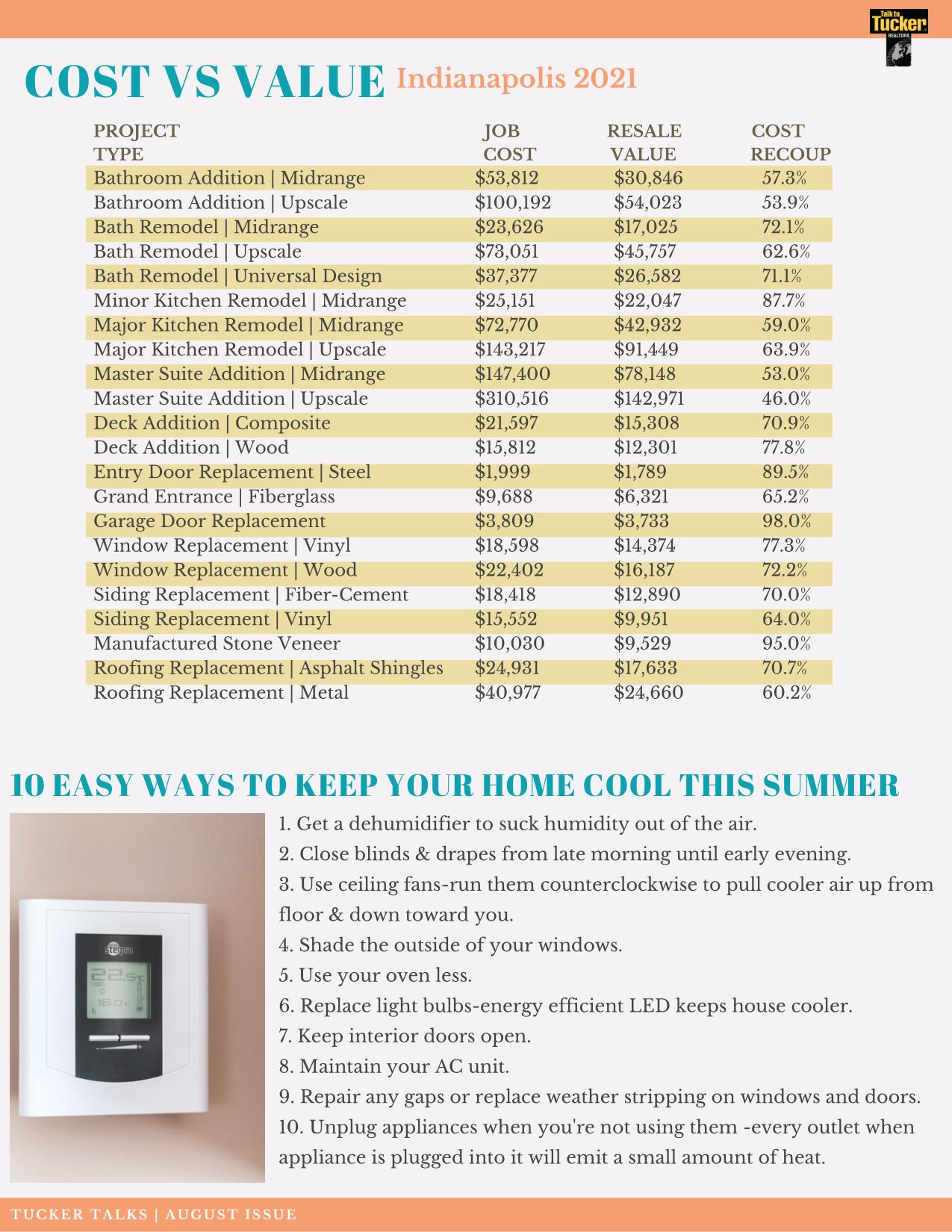
Many of my friends, family, neighbors and clients, if they didn’t choose to move within the past 18 months, have chosen to invest in home improvements. Many times I’m asked if a particular improvement will have a solid rate of return when/if they sell in the near future.
Going into the fall months, I thought you would benefit from the below information. And please pass it on to a friend!
This is a general guideline. Neighborhoods and markets can vary in regard to the value of a particular improvement so if you’re considering any of the below and wonder if you’ll recoup your costs when you sell sometime in the future, give me a call!
I’m also NEVER too busy for your referrals so, please consider mentioning me during conversations about home buying, selling or building. I’m honored and grateful for your support!
As we move into the second half of the year, one thing is clear: the current real estate market is one for the record books. The exact mix of conditions we have today creates opportunities for both buyers and sellers. Here’s a look at four key components that are shaping this unprecedented market.
A Shortage of Homes for Sale
Earlier this year, the number of homes available for sale fell to an all-time low. In recent months, however, inventory levels are starting to trend up. The latest Monthly Housing Market Trends Report from realtor.com says:
“In June, newly listed homes grew by 5.5% on a year-over-year basis, and by 10.9% on a month-over-month basis. Typically, fewer newly listed homes appear on the market in the month of June compared to May. This year, growth in new listings is continuing later into the summer season, a welcome sign for a tight housing market.”
This is good news for buyers who crave more options. But even though we’re experiencing small gains in the number of available homes for sale, inventory remains a challenge in most states. That’s why it’s still a sellers’ market, giving homeowners immense leverage when they decide to make a move.
Buyer Competition and Bidding Wars
Today’s ongoing low supply, coupled with high demand, creates a market characterized by high buyer competition and bidding wars. Buyers are going above and beyond to make sure their offer stands out from the crowd by offering over the asking price, all cash, or waiving some contingencies. The number of offers on the average house for sale broke records this year – and that’s great news for sellers.
The latest Confidence Index from the National Association of Realtors (NAR) says the average home for sale receives five offers (see graph below):For buyers, the best way to put a compelling offer together is by working with a local real estate professional. That agent can act as your trusted advisor on what terms are best for you and what’s most appealing to the seller.
Home Price Appreciation
The competition among buyers is driving prices up. Over the past year, we’ve seen home price appreciation rise across the country. According to the most recent Home Price Index (HPI) from CoreLogic, national home prices increased 15.4% year-over-year in May:
“The May 2021 HPI gain was up from the May 2020 gain of 4.2% and was the highest year-over-year gain since November 2005. Low mortgage rates and low for-sale inventory drove the increase in home prices.”
Rising home values are a big part of why real estate remains one of the top sought-after investments for Americans. For potential sellers, it also means it’s a great time to list your house to maximize the return on your investment.
A Rise in Home Values and Equity
The equity in a home doesn’t just grow when a homeowner pays their mortgage – it also grows as the home’s value appreciates. Thanks to the jump in price appreciation, homeowners across the country are seeing record-breaking gains in home equity. CoreLogic recently reported:
“…homeowners with mortgages (which account for roughly 62% of all properties) have seen their equity increase by 19.6% year over year, representing a collective equity gain of over $1.9 trillion, and an average gain of $33,400 per borrower, since the first quarter of 2020.”
That’s a major perk for households to leverage. Homeowners can use that equity to accomplish major life goals or move into their dream homes.
Bottom Line
If you’re thinking about buying or selling, there’s no time like the present. Let’s connect to talk about how you can take advantage of the conditions we’re seeing today to meet your homeownership goals.
07/20/2021 Bought a Single Family home in 2021 in Indianapolis, IN.
Local knowledge ***** Process expertise ***** Responsiveness ***** Negotiation skills *****
It was my Fiancé and I’s first time buying a home, and throughout the entire process Shawna brought such a calming presence. On top of that she was incredibly responsive, timely, and knew just how much information to give us to keep us informed but not overwhelmed. Additionally, Shawna was able to move through an expedited close timeline (about 3 weeks), with no pause or hesitation.
I personally cannot recommend Shawna enough for someone who is looking for more than just a Realtor, but also a confidant and friend.
With home prices continuing to deliver double-digit increases, some are concerned we’re in a housing bubble like the one in 2006. However, a closer look at the market data indicates this is nothing like 2006 for three major reasons.
1. The housing market isn’t driven by risky mortgage loans.
Back in 2006, nearly everyone could qualify for a loan. The Mortgage Credit Availability Index (MCAI) from the Mortgage Bankers’ Association is an indicator of the availability of mortgage money. The higher the index, the easier it is to obtain a mortgage. The MCAI more than doubled from 2004 (378) to 2006 (869). Today, the index stands at 130. As an example of the difference between today and 2006, let’s look at the volume of mortgages that originated when a buyer had less than a 620 credit score.Dr. Frank Nothaft, Chief Economist for CoreLogic, reiterates this point:
“There are marked differences in today’s run up in prices compared to 2005, which was a bubble fueled by risky loans and lenient underwriting. Today, loans with high-risk features are absent and mortgage underwriting is prudent.”
2. Homeowners aren’t using their homes as ATMs this time.
During the housing bubble, as prices skyrocketed, people were refinancing their homes and pulling out large sums of cash. As prices began to fall, that caused many to spiral into a negative equity situation (where their mortgage was higher than the value of the house).
Today, homeowners are letting their equity build. Tappable equity is the amount available for homeowners to access before hitting a maximum 80% combined loan-to-value ratio (thus still leaving them with at least 20% equity). In 2006, that number was $4.6 billion. Today, that number stands at over $8 billion.
Yet, the percentage of cash-out refinances (where the homeowner takes out at least 5% more than their original mortgage amount) is half of what it was in 2006.
3. This time, it’s simply a matter of supply and demand.
FOMO (the Fear Of Missing Out) dominated the housing market leading up to the 2006 housing bubble and drove up buyer demand. Back then, housing supply more than kept up as many homeowners put their houses on the market, as evidenced by the over seven months’ supply of existing housing inventory available for sale in 2006. Today, that number is barely two months.
Builders also overbuilt during the bubble but pulled back significantly over the next decade. Sam Khater, VP and Chief Economist, Economic & Housing Research at Freddie Mac, explains that pullback is the major factor in the lack of available inventory today:
“The main driver of the housing shortfall has been the long-term decline in the construction of single-family homes.”
Here’s a chart that quantifies Khater’s remarks:Today, there are simply not enough homes to keep up with current demand.
Bottom Line
This market is nothing like the run-up to 2006. Bill McBride, the author of the prestigious Calculated Risk blog, predicted the last housing bubble and crash. This is what he has to say about today’s housing market:
“It’s not clear at all to me that things are going to slow down significantly in the near future. In 2005, I had a strong sense that the hot market would turn and that, when it turned, things would get very ugly. Today, I don’t have that sense at all, because all of the fundamentals are there. Demand will be high for a while because Millennials need houses. Prices will keep rising for a while because inventory is so low.”
“Shawna is a great communicator and is always on top of all the details. We worked great together on this complicated transaction which resulted in both Buyer and Seller being very satisfied. I would love to work with Shawna again in the future.”