Shawna O'Brien, Realtor/Broker Indy, Geist, Fishers, Carmel & all surrounding areas
Author: indianapolisareahomesforsale
You deserve an advocate in the home selling and buying process who will educate, guide with honesty & integrity your best interest at the core. You deserve to be represented by someone who knows the market, communicates promptly & is not afraid to negotiate. You deserve someone who will understand your expectations, advise throughout the process & market your home to achieve a top dollar offer.
It’s my honor & privilege to assist you. When you partner with me, I will provide the best customer care before, during & after the home sells. Using my extensive knowledge of the real estate industry & current markets, I will devote my time & efforts assisting you to make the best long term decision for your personal happiness & financial future.
You can depend on me to be well versed in the home selling and buying process & to share my network of professionals for your benefit.
My background is in banking, lending, sales and marketing. I'm dedicated to my Husband & two children; volunteering at church & helping my community is important to me. I'm tenacious, a strong communicator and achiever which has contributed to my professional success.
As the Holiday season comes to an end and the new year is upon us, I’m reminded (with all matters personally and professionally) it’s not the destination, but it’s the journey.
Wishing for you that each day of your journey in the coming year is filled with positivity, success, laughter, and blessings.
If you’re thinking of buying a home, you’re probably wondering what you need to save for your down payment. Is it 20% of the purchase price, or could you put down less? While there are lower down payment programs available that allow qualified buyers to put down as little as 3.5%, it’s important to understand the many perks that come with a 20% down payment.
Here are four reasons why putting 20% down may be a great option if it works within your budget.
1. Your Interest Rate May Be Lower
A 20% down payment vs. a 3-5% down payment shows your lender you’re more financially stable and not a large credit risk. The more confident your lender is in your credit score and your ability to pay your loan, the lower the mortgage interest rate they’ll likely be willing to give you.
2. You’ll End Up Paying Less for Your Home
The larger your down payment, the smaller your loan amount will be for your mortgage. If you’re able to pay 20% of the cost of your new home at the start of the transaction, you’ll only pay interest on the remaining 80%. If you put down 5%, the additional 15% will be added to your loan and will accrue interest over time. This will end up costing you more over the lifetime of your home loan.
3. Your Offer Will Stand Out in a Competitive Market
In a market where many buyers are competing for the same home, sellers often like to see offers come in with 20% or larger down payments. The seller gains the same confidence as the lender in this scenario. You are seen as a stronger buyer with financing that’s more likely to be approved. Therefore, the deal will be more likely to go through.
4. You Won’t Have To Pay Private Mortgage Insurance (PMI)
“For homeowners who put less than 20% down, Private Mortgage Insurance or PMI is an added insurance policy for homeowners that protects the lender if you are unable to pay your mortgage.
It is not the same thing as homeowner’s insurance. It’s a monthly fee, rolled into your mortgage payment, that’s required if you make a down payment less than 20%. . . . Once you’ve built equity of 20% in your home, you can cancel your PMI and remove that expense from your monthly payment.”
As mentioned earlier, if you put down less than 20% when buying a home, your lender will see your loan as having more risk. PMI helps them recover their investment in you if you’re unable to pay your loan. This insurance isn’t required if you’re able to put down 20% or more.
Many times, home sellers looking to move up to a larger or more expensive home are able to take the equity they earn from the sale of their house to put 20% down on their next home. With the equity homeowners have today, it creates a great opportunity to put those savings toward a larger down payment on a new home.
Bottom Line
If you’re looking to buy a home, consider the benefits of 20% down versus a smaller down payment option. Let’s connect so you have expert advice to help make your homeownership goals a reality.
Once you’ve found your dream home and applied for a mortgage, there are some key things to keep in mind before you close. It’s exciting to start thinking about moving in and decorating your new place, but before you make any large purchases, move your money around, or make any major life changes, be sure to consult your lender – someone who’s qualified to explain how your financial decisions may impact your home loan.
Here’s a list of things you shouldn’t do after applying for a mortgage. They’re all important to know – or simply just good reminders – for the process.
1. Don’t Deposit Cash into Your Bank Accounts Before Speaking with Your Bank or Lender.
Lenders need to source your money, and cash isn’t easily traceable. Before you deposit any amount of cash into your accounts, discuss the proper way to document your transactions with your loan officer.
2. Don’t Make Any Large Purchases Like a New Car or Furniture for Your Home.
New debt comes with new monthly obligations. New obligations create new qualifications. People with new debt have higher debt-to-income ratios. Since higher ratios make for riskier loans, qualified borrowers may end up no longer qualifying for their mortgage.
3. Don’t Co-Sign Other Loans for Anyone.
When you co-sign, you’re obligated. With that obligation comes higher debt-to-income ratios as well. Even if you promise you won’t be the one making the payments, your lender will have to count the payments against you.
4. Don’t Change Bank Accounts.
Remember, lenders need to source and track your assets. That task is much easier when there’s consistency among your accounts. Before you transfer any money, speak with your loan officer.
5. Don’t Apply for New Credit.
It doesn’t matter whether it’s a new credit card or a new car. When you have your credit report run by organizations in multiple financial channels (mortgage, credit card, auto, etc.), your FICO® score will be impacted. Lower credit scores can determine your interest rate and possibly even your eligibility for approval.
6. Don’t Close Any Credit Accounts.
Many buyers believe having less available credit makes them less risky and more likely to be approved. This isn’t true. A major component of your score is your length and depth of credit history (as opposed to just your payment history) and your total usage of credit as a percentage of available credit. Closing accounts has a negative impact on both of those determinants of your score.
Bottom Line
Any blip in income, assets, or credit should be reviewed and executed in a way that ensures your home loan can still be approved. If your job or employment status has changed recently, share that with your lender as well. The best plan is to fully disclose and discuss your intentions with your loan officer before you do anything financial in nature.
November saw another unusually active residential real estate market in central Indiana; home sales and prices continue to increase
While half of central Indiana counties saw housing inventory increases in November, the seller’s market continued with both home sales and home prices increasing. Monthly real estate statistics from F.C. Tucker Company revealed that November 2021 pended home sales increased 6.9 percent compared to November 2020. Year-to-date home sale prices increased 12.2 percent, and central Indiana housing inventory decreased 18.4 percent overall compared to this time last year.
• The average November 2021 home sale price for the 16-county central Indiana region was $288,685, an increase of 11.3 percent.
• Pended home sales increased, up 6.9 percent compared to this time last year.
• Available housing inventory continued to decrease, down 18.4 percent compared to November 2020.
Happy December! I hope you had a wonderful Thanksgiving and you are looking forward to Christmas and the New Year. As the year comes to a close and we look forward to 2022, many are asking, “What is going to happen next year?” with our housing market.
SELLERS:
Like most industries, residential real estate typically has a seasonality to it. Historically, the number of buyers and listings for sale significantly increase in the spring and remains strong throughout the summer. Instead of waiting for the normal spring buying market, new research indicates that homeowners thinking about selling are about to put their homes on the market this winter.
Speaking to the release of a report on this recent research, George Ratiu, Manager of Economic Research for realtor.com, said: “The pandemic has delayed plans for many Americans, and homeowners looking to move on to the next state of life are no exception. Recent survey data suggests the majority of prospective sellers are actively preparing to enter the market this winter”.
Here are some highlights of the report:
Of homeowners planning to enter the market in the next year:
65% – Have just listed (19%) or plan to list this winter
93% – Have already taken steps toward listing their home, including working with an agent (28%)
36% – Have researched the value of their home and others in their neighborhood
36% – Have started making repairs or decluttering
The report also discusses the reasons sellers want to move:
33% – Have realized they want different home features
37% – Say their home no longer meets their family’s needs
32% – Want to move closer to friends and family
23% – Are looking for a home office
Data shows buyer demand remains unusually strong going into this winter. Research indicates the supply of inventory is about to increase. This could be a winter real estate market like never before.
BUYERS:
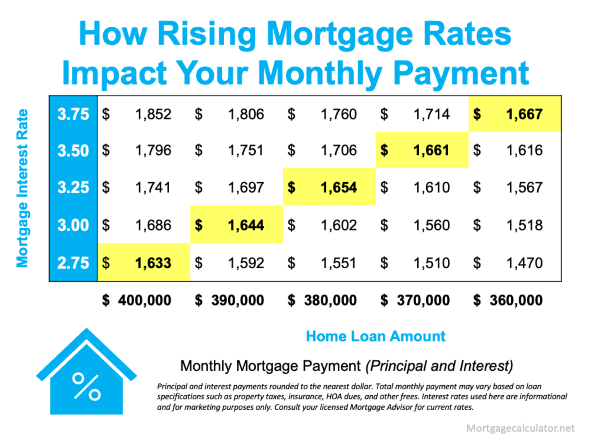
Rates have gone up slightly BUT they are still super low. When you amortize the payment over a 30 year term the increased rate may only equal a $50-$100 increase in the mortgage payment (depending on the home value) compared to this past summer.
So, PLEASE, encourage those you know who have spoken about buying a home this season to pursue their dream and contact me for guidance. I’d LOVE to help them! I can assist with working numbers and payment options as well as referring them to trusted lenders I’ve worked with in the past.
PRICING & APPRECIATION:
The recent surge in prices is the result of heavy buyer demand and a shortage of homes available for sale. Most experts believe that as more housing inventory comes to market (both new construction and existing homes), the supply and demand for housing will come more into balance. That balance will bring a lower rate of appreciation in 2022. Here’s a look at home price forecasts from six major entities, and they all project future appreciation:
While the projected rate of appreciation varies among the experts, due to things like supply chain challenges, virus variants, and more, it’s clear that home values will continue to appreciate next year.
Still have questions?? Although I prefer warmer weather, in the winter months I DO enjoy getting cozy in a big sweater, grabbing a hot coffee and talking with friends. So, let’s meet up for a coffee (or tea) and talk!
It’s impossible to research the subject of buying a home without coming across a headline declaring that the fall in home affordability is a crisis. However, when we add context to the most recent affordability statistics, we soon realize that, though homes are less affordable than they have been over the last few years, they are more affordable than they historically have been.
Black Knight, a premier provider of data and analytics for the mortgage industry, just released their latest Monthly Mortgage Monitor which includes a new analysis of the affordability situation. Here’s what the report reveals:
“The monthly payment required to purchase the average priced home with a 20% down 30-year fixed rate mortgage increased by nearly 20% (+$210) over the first nine months of 2021, . . . It now requires 21.6% of the median household income to make the monthly mortgage payment on the average home purchase, the least affordable housing has been since 30-year rates rose to nearly 5% back in late 2018.”
Basically, the report shows that homes are less affordable today than at any other time in the last three years. However, in a previous report earlier this year, Black Knight calculated that the percentage of the median household income to make the monthly mortgage payment on the average home purchase over the last 25 years was 23.6% (see graph below):Today’s payment-to-income ratio is more affordable than the average over the last 25 years. Given that context, we can see that American households still have the same ability to be homeowners as their parents did 20 years ago.
This confirms the recent analysis of ATTOM Data resources where Todd Teta, Chief Product and Technology Officer, explains:
“The typical median-priced home around the U.S. remains affordable to workers earning an average wage, despite prices that keep going through the roof. Super-low interests and rising pay continue to be the main reasons why.”
Bottom Line
It’s true that it’s less affordable to buy a home today than it has been the last few years. However, it’s more affordable to buy today than the average over the last 25 years. In other words, homes are less affordable, but they’re not unaffordable. That’s an important distinction.
I hope you had a wonderful weekend and a Happy Halloween. For the first time we didn’t walk around and trick or treat with Jack and Kelly. They ran off with friends and Pat and I sat around a bonfire in our driveway, handing out candy to our neighborhood friends & trick or treaters. That’s the way it goes with teenagers :-).
This month I’d like to share the below article because it’s the question I’m asked the most:
What Does the Future Hold for Home Prices?
If you’re looking to buy or sell a house, chances are you’ve heard talk about today’s rising home prices. And while this increase in home values is great news for sellers, you may be wondering what the future holds. Will prices continue to rise with time, or should you expect them to fall?
To answer that question, let’s first understand a few terms you may be hearing right now.
Appreciation is an increase in the value of an asset.
Depreciation is a decrease in the value of an asset.
Deceleration is when something happens at a slower pace.
It’s important to note home prices have increased, or appreciated, for 114 straight months. To find out if that trend may continue, look to the experts. Pulsenomics surveyed over 100 economists, investment strategists, and housing market analysts asking for their five-year projections. In terms of what lies ahead, experts say the market may see some slight deceleration, but not depreciation.
Here’s the forecast for the next few years:As the graph above shows, prices are expected to continue to rise, just not at the same pace we’ve seen over the last year. Over 100 experts agree, there is no expectation for price depreciation. As the arrows indicate, each number is an increase, which means prices will rise each year.
Bill McBride, author of the blog Calculated Risk, also expects deceleration, but not depreciation: “My sense is the Case-Shiller National annual growth rate of 19.7% is probably close to a peak, and that year-over-year price increases will slow later this year.”
Ivy Zelman of Zelman & Associates agrees, saying: “. . . home price appreciation is on the cusp of flipping to a deceleratingtrend.”
A recent article from realtor.com indicates you should expect: “. . . annual price increases will slow to a more normal level, . . .”
What Does This Deceleration Mean for You?
What experts are projecting for the years ahead is more in line with the historical norm for appreciation. According to data from Black Knight, the average annual appreciation from 1995-2020 is 4.1%. As you can see from the chart above, the expert forecasts are closer to that pace, which means you should see appreciation at a level that’s aligned with a more normal year.
Experts expect price deceleration, not price depreciation over the coming years. If you’re a buyer, don’t expect a sudden or drastic drop in home prices – experts say it won’t happen. Instead, think about your homeownership goals and consider purchasing a home before prices rise further. If you’re a seller, the continued home price appreciation is good news for the value of your house.
Let’s connect to talk through what’s happening in the housing market today, where things are headed, and what it means for you.
If you’re looking to buy or sell a house, chances are you’ve heard talk about today’s rising home prices. And while this increase in home values is great news for sellers, you may be wondering what the future holds. Will prices continue to rise with time, or should you expect them to fall?
To answer that question, let’s first understand a few terms you may be hearing right now.
Appreciation is an increase in the value of an asset.
Depreciation is a decrease in the value of an asset.
Deceleration is when something happens at a slower pace.
It’s important to note home prices have increased, or appreciated, for 114 straight months. To find out if that trend may continue, look to the experts. Pulsenomics surveyed over 100 economists, investment strategists, and housing market analysts asking for their five-year projections. In terms of what lies ahead, experts say the market may see some slight deceleration, but not depreciation.
Here’s the forecast for the next few years:As the graph above shows, prices are expected to continue to rise, just not at the same pace we’ve seen over the last year. Over 100 experts agree, there is no expectation for price depreciation. As the arrows indicate, each number is an increase, which means prices will rise each year.
Bill McBride, author of the blog Calculated Risk, also expects deceleration, but not depreciation:
“My sense is the Case-Shiller National annual growth rate of 19.7% is probably close to a peak, and that year-over-year price increases will slow later this year.”
“. . . home price appreciation is on the cusp of flipping to a deceleratingtrend.”
A recent article from realtor.com indicates you should expect:
“. . . annual price increases will slow to a more normal level, . . .”
What Does This Deceleration Mean for You?
What experts are projecting for the years ahead is more in line with the historical norm for appreciation. According to data from Black Knight, the average annual appreciation from 1995-2020 is 4.1%. As you can see from the chart above, the expert forecasts are closer to that pace, which means you should see appreciation at a level that’s aligned with a more normal year.
If you’re a buyer, don’t expect a sudden or drastic drop in home prices – experts say it won’t happen. Instead, think about your homeownership goals and consider purchasing a home before prices rise further.
If you’re a seller, the continued home price appreciation is good news for the value of your house. Work with an agent to list your house for the right price based on market conditions.
Bottom Line
Experts expect price deceleration, not price depreciation over the coming years. Let’s connect to talk through what’s happening in the housing market today, where things are headed, and what it means for you.





![Your Home Equity Is Growing [INFOGRAPHIC] | MyKCM](https://files.mykcm.com/2021/10/18091034/20211022-MEM-1046x2053.png)



 Indianapolis Area Homes for Sale